Why AI-Generated Images Can Be Difficult to Turn Into Signs
BLUF (Bottom line Up Front!): AI can create beautiful concepts very quickly. The challenge is that a beautiful computer image is not always a production-ready logo. Before it can be carved, routed, cut, printed, fabricated, or installed as a physical sign, the artwork often has to be professionally rebuilt.
Five reasons an AI-generated images can create challenges
AI creates images from patterns it has learned, so the result can look generic or similar to other existing designs.
A logo has to work on signs, vehicles, uniforms, business cards, websites, embroidery, and one-color applications.
Letter shapes, spacing, and proportions may look close at first glance but can be difficult to reproduce cleanly.
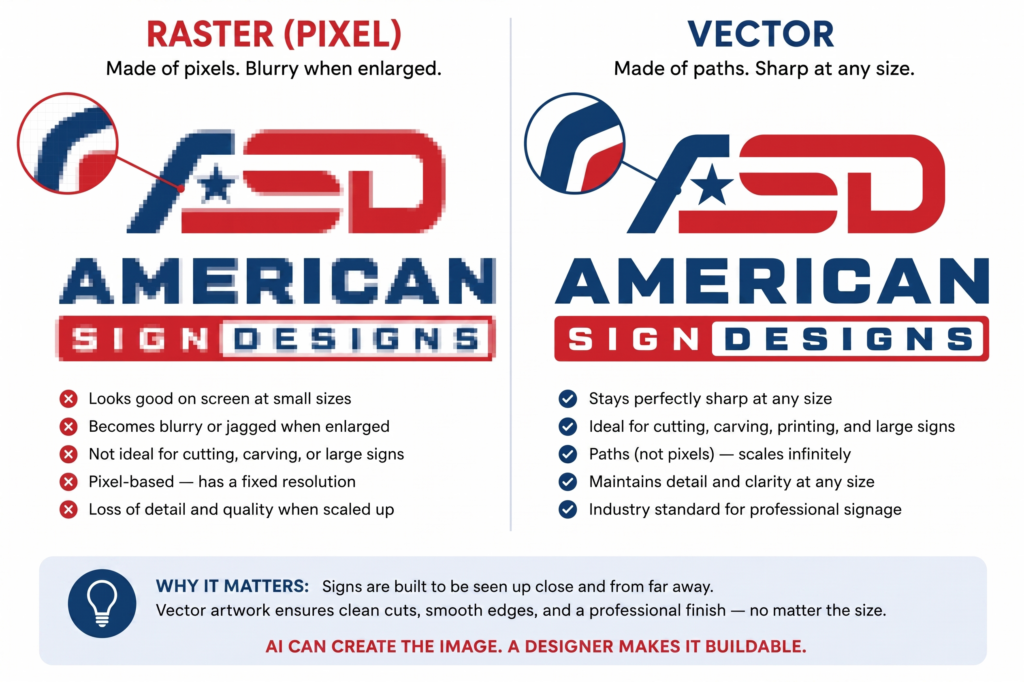
AI typically creates a raster image made of pixels. Professional sign production often requires clean vector artwork made from precise shapes and lines.
Your logo should remain consistent and reproducible for years. AI is excellent for ideas and inspiration, but the final artwork usually needs professional refinement.
Why AI artwork is harder to reproduce as a physical sign
AI creates pictures, not construction drawings.
AI generates a finished-looking image from pixels. A sign designer needs actual shapes, outlines, dimensions, curves, and cut paths that fabrication equipment can follow.
The edges are rarely as clean as they look.
When enlarged, AI artwork often contains fuzzy edges, tiny bumps, blended colors, shadows, and other details that are difficult to cut, route, carve, or fabricate.
AI often adds unnecessary detail.
Small textures, highlights, gradients, decorative marks, and irregular shapes may look attractive on screen but can become expensive or impractical when converted into a physical sign.
Typography can be especially difficult.
AI-generated letters may not come from a real font. Designers may need to identify a close font, redraw the letters, or recreate the wording so it is consistent and professional.
Symmetry and spacing may only appear correct.
Two sides of an AI logo can look balanced while actually having different curves, angles, spacing, or line thicknesses. These differences become much more obvious at sign scale.
Effects do not always translate into materials.
Glows, shadows, metallic effects, depth, and gradients can be easy to display on a monitor but may require multiple materials, paint colors, layers, routed depths, or fabrication methods to reproduce.
Raster vs. Vector: the simplest way to understand the difference
A raster image is made from tiny colored squares called pixels. A vector image is built from clean shapes and paths. For sign fabrication, vector artwork is usually the better starting point because it can be enlarged, cut, carved, routed, printed, and reproduced much more cleanly.
Why design and artwork-preparation charges may be necessary
When a customer provides an intricate AI-generated image for a dimensional, carved, routed, or cut sign, the design charge is not simply for “converting the file.”
The designer may need to:
- Rebuild the artwork as clean vector shapes.
- Correct distorted letters, spacing, curves, and symmetry.
- Simplify details that cannot be carved, routed, cut, or fabricated reliably.
- Separate colors, layers, depths, and materials for production.
- Create clean cut paths for routers, CNC equipment, plotters, or laser cutters.
- Adjust very thin lines, tiny gaps, or fragile details so the finished sign will be durable.
- Preserve the overall look of the AI concept while making it physically manufacturable.
For carved and dimensional HDU signs
This becomes especially important with carved or dimensional HDU signs. A computer image can show extremely fine detail, subtle shading, or complex textures that a router or carving tool simply cannot reproduce at the same scale. The artwork must be translated into realistic shapes, depths, paint areas, and tool paths.
The more intricate the AI artwork, the more design time may be required before fabrication can even begin. That does not mean the design is impossible—it means the image has to be professionally interpreted and rebuilt for the materials and manufacturing process being used.
The practical takeaway
AI is an excellent tool for creating ideas. It can show a customer what is possible and help establish a visual direction very quickly. But an AI image should usually be treated as a concept, not as finished sign-production artwork.
For professional fabrication, the concept may need to be cleaned up, simplified, redrawn, and converted into accurate vector artwork. That design work is what allows the finished sign to look like the original idea while also being clean, durable, repeatable, and manufacturable.